 ▾
▾AI in schools: How is it already changing our children's education?
Robots in schools? Don't worry, teachers won't lose their jobs. Artificial intelligence (AI) is indeed changing education, but according to experts, human creativity and critical thinking are still key. Find out how ChatGPT and other AI tools can assist both students and teachers.
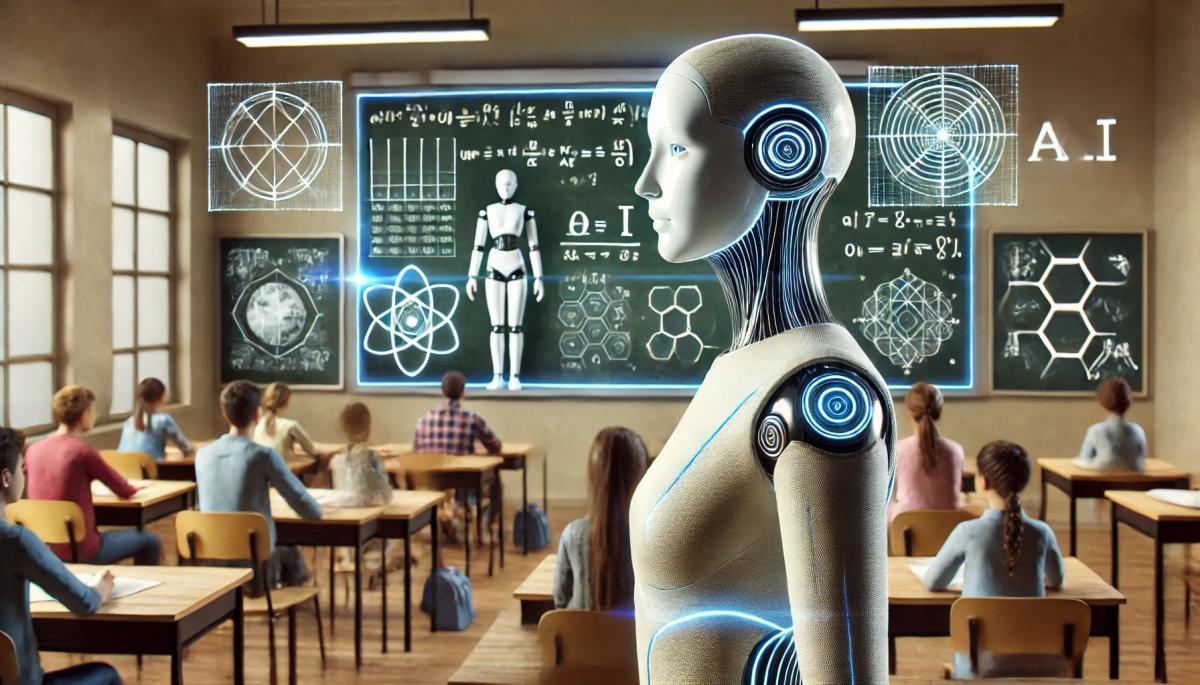
Artificial intelligence (AI) is changing the rules of the game in education. Tools like ChatGPT are now used not only by enthusiasts but also by much of the public. With this, questions arise on how to find a balance between technologies and established teaching methods.
AI: more than just a digital assistant
AI is no longer just about searching for information. Modern platforms can generate texts, provide feedback, propose creative solutions, and much more. For educators, this poses the crucial question: 'How to harness the potential of AI without losing the human factor in education?'
According to many experts, the key is to find a balance between technological advancement and the development of critical thinking, ethical reasoning, and creativity. These are precisely the skills that AI cannot yet replace.
AI can offer us mountains of information and solutions, but it's up to us to evaluate them critically. Students must learn to ask questions, verify facts, and assess the ethical impacts of AI-generated outputs. In practice, this might mean that AI proposes a marketing strategy, but the student must consider its feasibility, relevance, and ethical aspects.
Learning by doing: projects and collaboration with AI
Project-based and investigative learning using AI opens up new possibilities. Students learn to analyze data with the help of AI tools while also focusing on the interpretation and application of acquired knowledge in real-life situations.
Collaboration with companies on real projects allows them to apply theoretical knowledge in practice and gain valuable experience. The development of communication skills is equally important since AI can generate texts, but it lacks empathy, creativity, and the ability to engage the audience.
Ethics and AI: responsible use of technology
With the growing influence of AI, it is essential to focus on the ethical aspects of its use. Students must learn to recognize potential risks, such as bias, privacy violations, and lack of transparency.
AI can be an excellent helper in generating ideas, but true creativity requires a human approach. Therefore, students learn how to develop and enrich AI-generated proposals with their own ideas and innovations. Teachers should strive to teach students that AI won't do everything for them but will only assist them.
Assessment in the AI era: emphasis on process and understanding
Traditional tests based on memorization are no longer sufficient in the AI era. According to some experts, assessments should focus on the learning process, understanding, adaptability, and effective use of AI.
It is important to monitor how students reach conclusions, analyze, and modify AI-generated outputs, and how they apply gained knowledge in practice. Teachers themselves need to keep educating themselves. Many schools will thus face investments in training, not only for teaching staff.
AI in education represents immense potential as well as challenges. Nonetheless, we should view AI as a partner that helps us develop human capabilities and prepare students for a future full of technologies. Only in this way can we ensure that we use artificial intelligence wisely and do not leave it in the hands of only a few.
Phone instead of a card or key. What is NFC and how does it work?

Just hold your phone up to a terminal and within moments the payment is made. However, NFC technology is capable of much more. We will explain what NFC is and how it works, what actually happens during NFC mobile payments, what else you can use it for, and how secure it is. We will also show what NFC tags are and how they can simplify some daily tasks.
What would happen if the internet went down for a day?

What if there was a full-day internet outage? An immediate collapse of society wouldn't occur, but daily operations would quickly become complicated because today's world is more dependent on the internet than we often realize. Which services would stop functioning first, and what would happen with payments, transportation, or work?
WPA, WPA2, WPA3: Which Wi-Fi security should you use today?

WPA, WPA2, WPA3, AES or TKIP? Wi-Fi security settings might initially seem unnecessarily complicated. However, when you understand what each abbreviation stands for, it becomes fairly simple. Therefore, we'll explain the differences between them and which is the best choice today. We'll also suggest what settings to choose if you have older devices at home that don't support the latest standard.
Is incognito mode really anonymous? Who still sees what you're doing

Do you think incognito mode hides you from everyone on the internet? In reality, it works a bit differently. We explain what it actually does, when it's sensible to use it, who can still see your activity, and whether history can be traced in incognito mode.
Why Does AI Hallucinate? A Peek Under the Hood of Language Models

AI can answer almost any question in just a few seconds. However, sometimes it confidently states information that is not true. Why does this happen and what are so-called AI hallucinations? In this article, we'll explain how large language models work, why they sometimes create false answers and how developers are gradually trying to mitigate this issue.
What is a CDN and why is internet content copied worldwide

Behind every loaded video, photo, or webpage is a technology called CDN. It is used by streaming services, social networks, and regular websites, yet many people have never heard of it. In this article, we will explain what this abbreviation means, how it works, why internet content is stored in various locations around the world, and why today's internet can hardly do without it.